
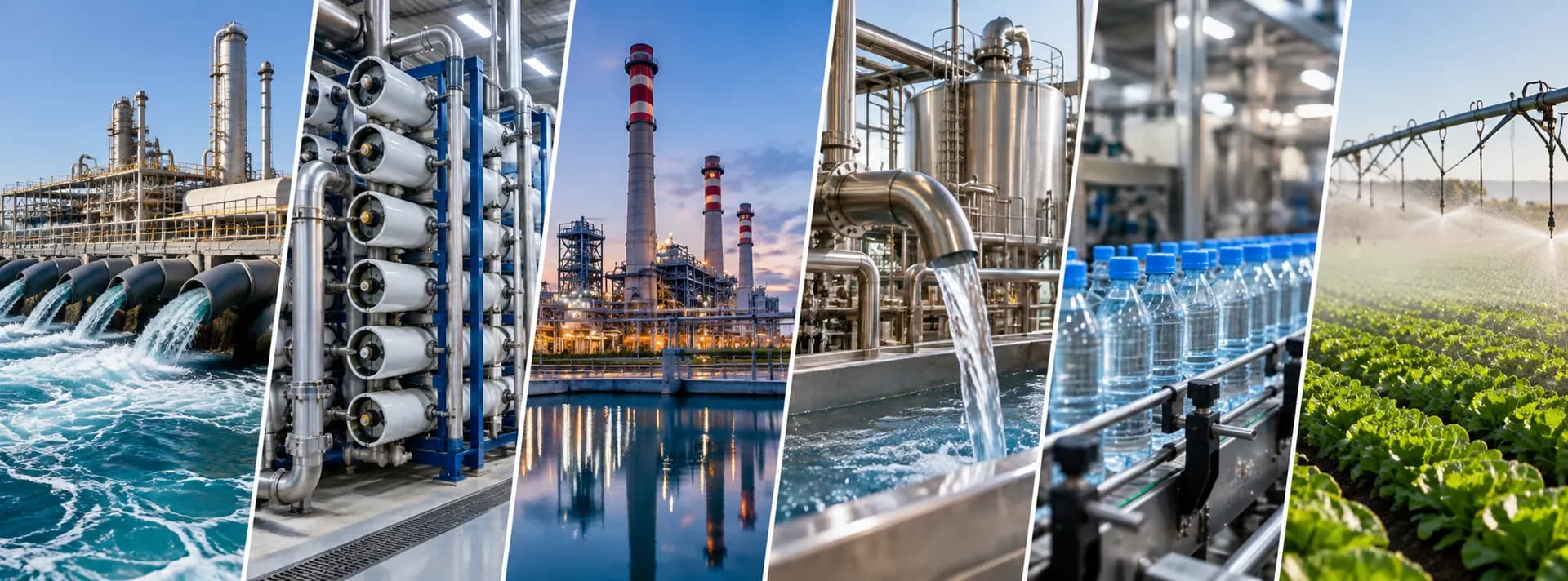
RO application contexts
Different RO Applications Require Different Enquiry Inputs
Explore how an RO antiscalant enquiry may differ across operating plants, desalination, industrial water treatment, and commercial or institutional systems.
Industry context helps define the enquiry, while product selection and dosing are evaluated against the relevant water chemistry, RO system conditions and product-specific information.
The same product enquiry can begin with a different operational need
An RO plant operator may be responding to changing feedwater or performance data. An EPC contractor may be preparing a project specification. An industrial procurement team may need documentation and supply terms. A facility manager may need a practical replacement or purchasing route for a smaller distributed system.
These contexts change:
- who holds the technical information;
- how complete the water and system data may be;
- which documents are required;
- whether the need relates to a new project, an operating review, or a procurement requirement;
- how the RFQ should be structured.
In every case, the technical review remains grounded in the actual water chemistry and RO operating conditions.
Select the environment closest to your requirement
Reverse Osmosis Plants
- For
- Plant operators, water-treatment companies, service providers and plant managers
Operating-plant enquiries may involve an existing antiscalant programme, a change in recovery, a new water source, replacement procurement, documentation review, or a suspected scaling concern.
Typical information:
- recent water analysis;
- actual recovery;
- pretreatment;
- membrane details;
- operating trends;
- current chemical programme.
Desalination
- For
- Desalination stakeholders, EPC contractors, consultants and procurement teams
Desalination enquiries may involve seawater or brackish-water conditions, project specifications, pretreatment design, membrane requirements, high-salinity operation, and detailed product or supplier documentation.
Typical information:
- feedwater source and analysis;
- design basis;
- recovery;
- pretreatment;
- membrane information;
- specification;
- project procurement requirements.
Industrial Water Treatment
- For
- Process engineers, industrial users, utilities teams and procurement
Industrial RO often forms part of a wider water-treatment or production process. The enquiry may need to consider the role of the permeate, continuity requirements, source-water variability, site chemical controls, and documentation requirements.
Typical information:
- process purpose;
- feedwater;
- RO design and operation;
- pretreatment;
- current programme;
- site restrictions;
- purchasing specification.
Commercial and Institutional RO
- For
- Facility teams, water-treatment service companies, hospitality, healthcare, education and commercial operators
Commercial and institutional systems may be smaller or distributed, but a useful enquiry still requires clear product identification, feedwater and system information, current treatment details, and purchasing requirements.
Typical information:
- application;
- water source;
- system capacity;
- recovery if known;
- membrane details if known;
- current product;
- required quantity.
Distinct enquiry priorities
The required depth and decision path may differ
| Context | Common starting point | Information emphasis | Likely next route |
|---|---|---|---|
| Operating RO plant | Performance, water or product change | Actual operating data, current programme and trends | Water Analysis |
| Desalination project or plant | Project specification or high-salinity feed | Design basis, pretreatment, membrane and documentation | Water Analysis / RFQ |
| Industrial water treatment | Process-water requirement | Role of permeate, continuity, site constraints and procurement | Discuss Requirement |
| Commercial/institutional RO | Replacement, service or purchasing need | System identification, required quantity, and documentation | RFQ / Contact |
Water, system, and product information still need to be reviewed together
Across all four industry groups, the core review may need:
- a recent water analysis with units;
- feedwater source and variability;
- system capacity and recovery;
- membrane and staging information, where known;
- pretreatment and current chemicals;
- the operating or purchasing reason for the enquiry;
- product identification and available technical documentation;
- delivery and commercial requirements when a quotation is requested.
Together, these inputs establish the technical and commercial basis for an application-specific review.
Find your next step
Routes for different stakeholders
Operators and Plant Managers
Use the Water Analysis route when the need relates to actual system conditions, changing water, current treatment or a suspected technical issue.
Engineers, Consultants and EPC Contractors
Provide the design basis, technical specification and available calculations or system data. Clearly identify whether the request is for product evaluation, an approved-equivalent review, or a quotation.
Procurement Teams
Use the RFQ route when the required product or specification is defined. Include quantity, destination, timing and documentation requirements.
Water-Treatment Companies and Service Providers
State whether the enquiry relates to an end user, project, replacement programme, or distribution requirement, and separate known technical information from assumptions.
Distributors and Resellers
Provide the target market, expected quantity, required documentation and purchasing stage. Territory, exclusivity and representation arrangements can be addressed separately where relevant to the proposed commercial relationship.
Information checklist
The most useful first submission depends on your stage
Technical-Stage Submission
- water analysis;
- system capacity and recovery;
- membrane and array, if known;
- pretreatment;
- current antiscalant or chemical programme;
- main technical concern;
- operating changes or relevant trends.
Commercial-Stage Submission
- product or specification;
- application and end-use context;
- estimated quantity;
- packaging preference, if defined;
- delivery destination or port;
- target timing;
- required documentation;
- attached RFQ or technical specification.
Early-Stage or Unclear Requirement
Provide a concise description of the application, country, current status, and the technical or commercial decision you need to make.
Product Evaluation Should Reflect the Specific Application
A product-specific evaluation should consider:
- the feed-water chemistry and projected concentrate conditions;
- RO recovery and operating conditions;
- membrane and pretreatment requirements;
- the scale risks relevant to the application;
- product-specific technical documentation;
- the commercial and logistics requirements of the target market.
Product selection, dosing, compatibility, documentation and commercial terms are established from the relevant technical evidence and transaction requirements.
Select the route that fits your application and buying stage
International enquiries are coordinated through ALPHX in Dubai, with availability, documentation, logistics and market-specific commercial requirements addressed as part of the individual enquiry.