
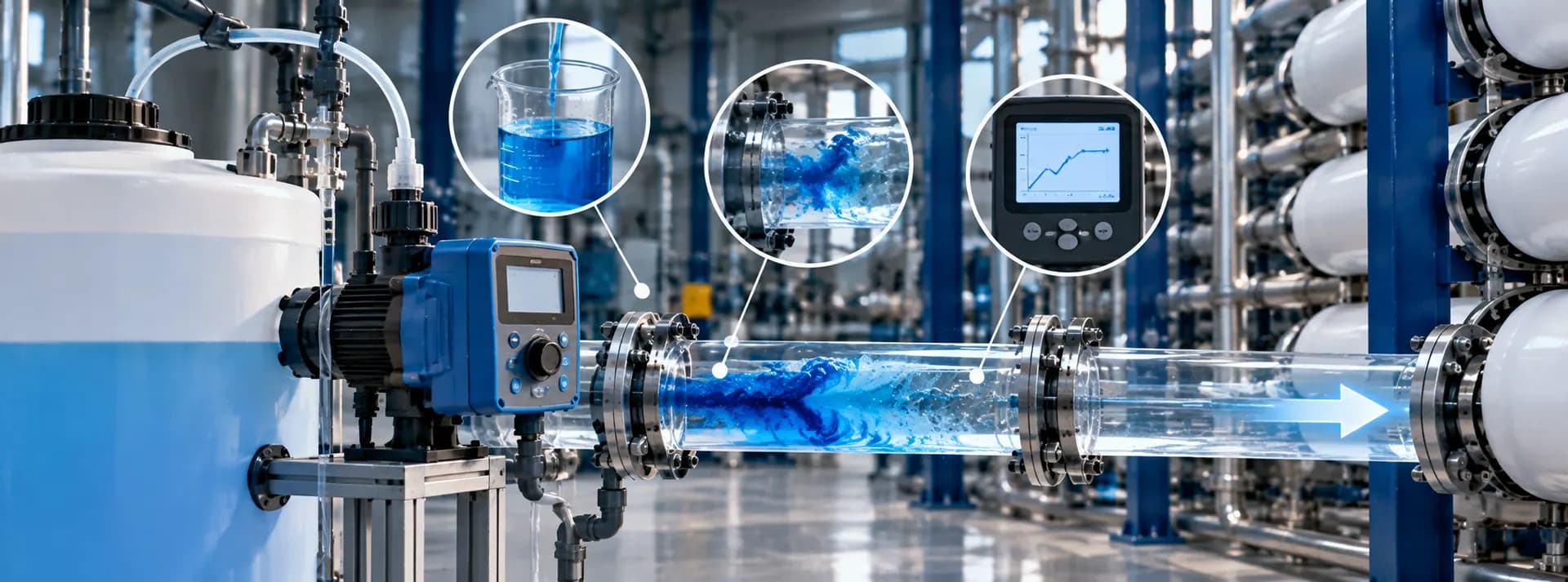
RO chemical dosing
A Responsible Antiscalant Dose Requires Both Product and System Data
Water chemistry, recovery, temperature, pretreatment, product formulation, injection conditions, mixing and actual feed flow can all affect the required dosing programme.
No universal ppm dose applies across all products and RO systems. Product-specific dosing should be confirmed using the relevant supplier-approved calculation or projection method.
Antiscalant Dose Cannot Be Selected from Flow Rate Alone
Plant capacity and actual feed flow are used to calculate chemical feed rate after the target product dose has been established. Capacity alone does not determine the required dose.
The product-specific dose may depend on:
- feedwater chemistry;
- concentrate saturation conditions;
- recovery and staging;
- temperature and pH;
- pretreatment;
- scale risks being controlled;
- membrane and application requirements;
- product formulation and concentration;
- manufacturer or supplier calculation method;
- product-specific operating limits and safety margins;
- actual feed flow and variability.
A generic dose copied from another plant can be technically unsuitable even when the nominal capacity is similar.
Start with a Complete Technical Basis
Water Chemistry
Provide the recent water analysis with units, sampling context and relevant low-level ions. The required panel depends on the scale risks under review.
RO Design and Operation
Include design and actual recovery, feed and concentrate flows, staging, membrane manufacturer and model, operating pressures, temperature and feed/concentrate pH where available.
Pretreatment
Describe clarification, filtration, softening, acid or caustic addition, dechlorination, coagulants and current chemicals.
Product Identity
State the exact product name, formulation or concentration where relevant when a defined product is being evaluated. If no product has been selected, do not assume that a dose established for one formulation applies to another.
Operating Envelope
Include seasonal water changes, blended sources, minimum and maximum flow, intermittent operation and planned recovery changes.
Antiscalant Products Do Not Share a Universal Performance Envelope
Antiscalants may use polymeric, phosphonate-based or blended chemistries. Their supported scale-control claims, application limits, dosing methods, dilution guidance and compatibility requirements can differ.
A valid product-specific recommendation should identify:
- the named product and the current approved revision of its technical documentation;
- the water-analysis date and basis;
- the calculation or projection method;
- design and operating recovery;
- temperature and pH assumptions;
- scale risks included in the evaluation;
- recommended dose, applicable operating range and product-specific limits;
- required monitoring or operating conditions;
- compatibility and regulatory requirements where relevant.
ALPHX publishes product-specific dosing or saturation guidance only when it is supported by the identified product’s approved technical documentation and calculation methodology.
A Sound Dose Calculation Still Requires an Operable Dosing System
The antiscalant should be injected at a location that provides adequate mixing before the RO membrane elements and is consistent with the approved chemical programme. The exact injection point depends on plant design, pretreatment configuration and potential interactions with other treatment chemicals.
Review:
- injection location;
- available mixing time and hydraulic conditions before the membrane train;
- static mixer or available hydraulic mixing;
- proximity to acid or coagulant injection;
- injection quill condition;
- non-return and isolation arrangements;
- tubing material and chemical compatibility;
- calibration column or verified flow-measurement method;
- duty/standby pump arrangement where required;
- alarms for low tank level, pump fault or no flow.
Inadequate mixing of acid, coagulant or antiscalant can create local chemical conditions that differ substantially from the intended bulk-water chemistry and may increase deposition or compatibility risks.
Dilution Changes Both Operating and Hygiene Requirements
Some installations dose the product neat, while others use an approved dilution to improve dosing-pump turndown, stroke frequency or chemical distribution. Any dilution ratio, water-quality requirement and storage limitation should follow the product supplier’s guidance.
A dilution review should address:
- approved dilution ratio or prohibition on dilution;
- dilution-water quality;
- tank cleanliness and material compatibility;
- batch size and residence time;
- agitation requirements;
- contamination or biological-growth risk;
- labelling and traceability;
- prevention of cross-contamination;
- safe handling and SDS requirements.
Dilution water should meet the product supplier’s requirements. Hardness, suspended solids, microbiological contamination or incompatible chemistry can affect solution stability, cleanliness and dosing reliability.
The Delivered Dose Should Reflect the Actual Feed Flow
A fixed dosing-pump output can overfeed or underfeed the antiscalant when RO feed flow changes. Where feed flow varies, chemical delivery may need to be paced to a verified flow signal in accordance with the approved control philosophy.
Operational checks may include:
- actual feed flow at the injection point;
- pump stroke or speed setting;
- measured chemical delivery over time;
- product density and concentration used in the calculation;
- calibration frequency;
- minimum pump turndown;
- pulsation and check-valve performance;
- control-signal scaling;
- tank-level reconciliation with calculated consumption;
- alarm and interlock tests.
A displayed pump percentage should not be treated as confirmed chemical delivery unless the pump output has been calibrated or otherwise verified under the actual system conditions.
A Higher Antiscalant Dose Does Not Automatically Provide Better Protection
Under-Dosing
An insufficient delivered dose may leave the intended scale-control objective unsupported. Causes can include calculation error, pump drift, blocked lines, empty tanks, changing flow, wrong product concentration or poor mixing.
Over-Dosing
Excessive dosing increases chemical consumption and, depending on the product chemistry, water composition and interacting substances, may contribute to deposition or fouling. It should not be used as an assumed safety margin.
Cationic Coagulants
Some anionic antiscalants can interact with residual cationic coagulants or cationic polymers and contribute to membrane deposition. The complete pretreatment chemical programme should therefore be included in the compatibility review.
Metals
Iron and aluminium can interact with some antiscalant chemistries or contribute to mixed deposits. Their concentration, form, source and pretreatment control should be reviewed.
Acid and pH Adjustment
Where acid and antiscalant are both used, their injection locations and mixing conditions should follow the approved chemical programme. Inadequate acid mixing can create local low-pH conditions and alter scale-control chemistry.
Dosing Control Extends Beyond the Pump Setting
A complete operating procedure should cover:
- confirming tank contents and product identity;
- verifying dilution and batch records;
- priming and calibrating the pump;
- confirming flow before dosing;
- start-up sequence;
- low-pressure flush and shutdown sequence;
- whether chemical feed should stop during flushing;
- avoiding prolonged stagnation of concentrated or diluted chemical solutions where this is restricted by the product guidance;
- monitoring normalised performance;
- recording product consumption;
- investigating deviations before changing the dose.
Operating procedures should follow the product supplier’s guidance, plant-specific requirements and the membrane manufacturer’s current recommendations.
Prepare a Complete Dosing-Focused Technical Package
Product and Documents
- exact product name, if defined;
- current Technical Data Sheet;
- current Safety Data Sheet;
- product concentration and density data required for dosing calculations;
- compatibility or approval evidence required by the project.
Water and RO System
- complete water analysis;
- recovery, flow, temperature and pH;
- membrane and array information;
- scale risks under review;
- seasonal or blended-water cases.
Dosing Equipment
- pump make and model;
- normal setting and turndown;
- measured calibration result;
- injection point;
- dilution practice;
- tank volume and batch practice;
- flow pacing and alarms;
- relevant photographs or P&ID extracts showing the dosing arrangement, where appropriate and permitted.
Commercial Requirement
- estimated quantity;
- delivery destination;
- required documents;
- target timing;
- packaging preference, if any.
Antiscalant Dosing FAQs
There is no responsible universal dose. It depends on the named product, water chemistry, recovery, temperature, pH, pretreatment and product-specific method.
Capacity converts a confirmed concentration into a chemical feed rate. It does not establish the required concentration.
Not automatically. Over-dosing can increase cost and may contribute to fouling or chemical interaction problems.
A recovery change alters concentrate conditions and should trigger review. Do not assume the previous dose remains valid.
Only according to the approved product guidance and plant design. Dilution water quality, hygiene, residence time and pump operation must be considered.
At an approved point that provides adequate mixing before the RO and fits the overall chemical sequence. The exact location is system-specific.
No. Chemical delivery should be calibrated or otherwise verified. Pump percentage alone does not confirm flow.
Include the coagulant chemistry, dose and carryover controls. Some antiscalants may interact with residual cationic material.
Only after a named product, approved calculation method, evidence controls and clear legal/technical limitations are established.
Send the water analysis, recovery, flows, temperature, pH, pretreatment, exact product if known, and details of the dosing equipment and operating pattern.
Prepare the full dosing basis
Connect the Dose Calculation to the Equipment That Delivers It
Submit the available water analysis and RO operating information. ALPHX will review the technical basis of the enquiry and determine the appropriate next step for product and dosing evaluation.