
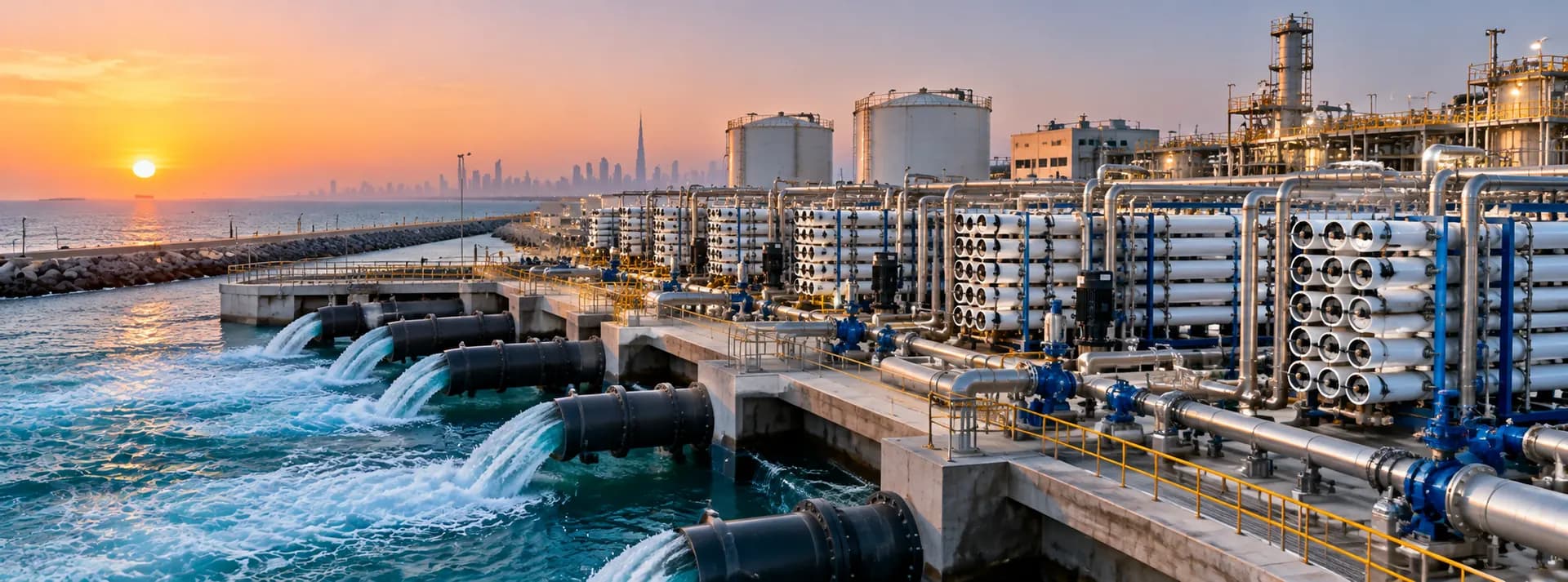
Desalination and high-salinity RO
Build the Antiscalant Enquiry Around the Source Water and Desalination Design
Seawater and brackish-water reverse osmosis (RO) systems can operate under very different salinity, recovery, pretreatment and membrane conditions. A well-supported antiscalant enquiry starts with the actual feedwater analysis and the relevant design or operating basis.
Product suitability, dosing, saturation limits and membrane compatibility must be confirmed for the specific desalination application.
Seawater, brackish water and other sources require separate context
RO is used for desalination across naturally saline waters, including seawater and brackish-water sources. Source-water composition, total salinity, seasonal variation, intake conditions, pretreatment and recovery can differ substantially between applications.
The enquiry should state:
- the source-water category and location context;
- whether the request relates to design, commissioning, operation or procurement;
- whether the analysis represents raw intake water, pretreated RO feedwater or another sampling point;
- expected and actual operating range;
- whether the project is new, an expansion, a replacement or a programme review.
Common desalination enquiry contexts
Seawater RO Plant or Project
The enquiry may require detailed source-water, temperature, intake and pretreatment information, along with the membrane and design basis. The high total salt concentration does not mean that every mineral species creates the same risk.
Brackish-Water Desalination
Brackish water typically has lower overall salinity than seawater but may contain a different balance of hardness, alkalinity, sulfate, silica, barium, strontium and other scale-forming constituents. RO recovery may also differ significantly.
Inland or Variable Saline Sources
Borewell, blended or seasonally variable sources may require representative analyses across the expected operating range rather than a single sample. Detection limits and reporting units can be especially important for barium and strontium because their sulfate salts have very low solubility.
Existing Plant Programme Review
Operating data, current product, actual consumption, recovery, pretreatment and performance trends should accompany the analysis.
Project RFQ or Approved-Equivalent Review
Provide the complete technical specification, named reference product where applicable, required documents, destination, quantity, timeline and approval process.
Feedwater chemistry must be evaluated against concentrate conditions
General Water Chemistry
- pH and temperature;
- conductivity, salinity or total dissolved solids basis;
- calcium and magnesium;
- alkalinity or bicarbonate basis;
- sulfate;
- silica concentration and analytical method, where available;
- barium and strontium with units and detection limits;
- iron, aluminium and other metals where relevant;
- turbidity, SDI and organic indicators where available.
Source-Water Context
- intake or source type;
- seasonal minimum, maximum and typical water-quality values;
- blending or pretreatment changes;
- sampling point and sample date;
- whether values are measured or design assumptions.
Concentration Basis
- design and actual recovery;
- stage or array configuration;
- concentrate recycle, blending or other special system configurations, where applicable;
- design software or calculation method used by the project team;
- critical operating temperature and pH basis.
Antiscalant is one part of a wider desalination treatment train
The pretreatment system can affect suspended solids, colloids, biological material, metals, coagulant carryover and RO feed consistency. An antiscalant enquiry should not treat mineral-scale control as a substitute for effective pretreatment.
Relevant information may include:
- open intake, beach well, borewell or other source arrangement;
- screening and clarification process;
- media filtration, ultrafiltration or other membrane pretreatment;
- coagulant and polymer programme;
- dechlorination or reducing-agent programme;
- cartridge-filter performance;
- acid or pH adjustment;
- intake events, algal conditions or seasonal changes where relevant;
- residual iron or aluminium concern.
ALPHX reviews pretreatment information as part of the antiscalant enquiry; desalination pretreatment design, operation and auditing are outside the scope of this page.
State whether the enquiry is for design or current operation
For a Design-Stage Enquiry
Provide:
- design feedwater envelope;
- target permeate capacity and quality;
- design recovery and staging;
- membrane manufacturer and model, if selected;
- pretreatment design basis;
- temperature range;
- required antiscalant selection or projection method, where specified;
- project specification and approved-vendor requirements.
For an Operating Plant
Provide:
- current water analysis;
- actual flows, recovery, pressure and temperature;
- current membrane and pretreatment condition;
- current antiscalant and dose basis;
- normalised performance trends where available;
- chemical consumption and dosing checks;
- the specific reason for review.
Desalination RFQs may require more than a price and pack size
A project or plant procurement team may request:
- Technical Data Sheet;
- Safety Data Sheet;
- Certificate of Analysis format or batch-document requirement;
- product identity and manufacturer information;
- country of origin;
- packaging and labelling requirements;
- shelf-life and storage documentation;
- membrane or project compatibility evidence;
- quality, regulatory or approved-vendor documents;
- estimated quantity and delivery schedule;
- destination port and preferred Incoterms® rule, where applicable;
- inspection, testing or document-approval workflow.
Document availability is confirmed for the specific proposed product and transaction.
Desalination FAQs
Prepare the desalination enquiry
Connect the source-water analysis to the design or operating basis
Submit the available water analysis and desalination-system information. ALPHX will review the application and establish the appropriate basis for product evaluation and commercial coordination.