
RO technical challenges
Identify the Technical Problem Before Selecting the Chemical
Explore common RO scaling topics, distinguish scaling from broader membrane fouling, and identify the information needed to prepare an antiscalant enquiry.
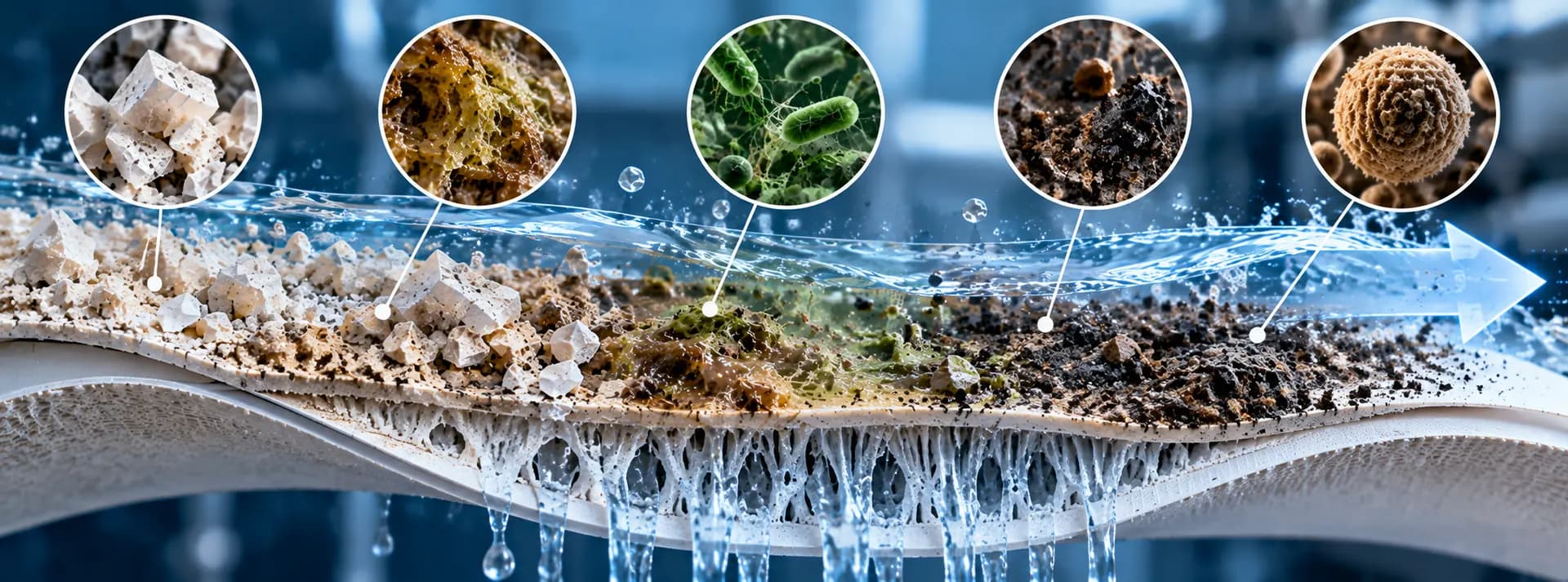
Mineral precipitation is only one possible deposition mechanism
In RO systems, scaling generally refers to the precipitation and deposition of sparingly soluble mineral salts as feedwater constituents become concentrated.
Fouling is a broader category. It may involve suspended solids, colloids, metal oxides, organic matter, biological growth or chemical interactions.
A deposit may involve more than one mechanism. For example, mineral precipitation can occur alongside colloidal or metal-related deposition. Therefore, changes in differential pressure, normalised permeate flow or salt passage should not automatically be attributed to scaling.
Explore the main technical topics
Silica Scaling
Silica-related scaling and deposition risk can depend on concentration, pH, temperature, recovery, silica form and interactions with metals or other constituents. Dissolved and colloidal silica should not be treated as interchangeable without supporting information.
Carbonate Scaling
Carbonate-scale potential is connected to calcium, alkalinity, pH, temperature, dissolved solids and concentration conditions. Acid addition and antiscalant treatment are different approaches and should be considered within the complete pretreatment programme.
Sulfate Scaling
Calcium sulfate, barium sulfate and strontium sulfate may become relevant as sulfate and the corresponding cations become concentrated in the RO reject stream. Accurate analytical data, including reliable low-level measurements where relevant, may be important for assessing sulfate-scale risk.
Membrane Scaling and Fouling
Pressure, flow and salt-passage changes can have different causes. This topic explains how scaling fits within the broader fouling picture and why diagnosis should be evidence-led.
Antiscalant Dosing Considerations
An appropriate antiscalant dose cannot be selected from system capacity alone. Water chemistry, recovery, temperature, pretreatment, product chemistry, injection and operating conditions can all matter.
Observe, then investigate
Operational changes can indicate a problem—but not necessarily its cause
Potential observations may include:
- increasing differential pressure;
- declining normalised permeate flow;
- increasing normalised salt passage;
- visible deposits;
- shortened operating intervals;
- more frequent cleaning;
- changes following a new water source, recovery target or chemical programme.
These observations should be reviewed alongside operating records, normalised performance data, feedwater and concentrate chemistry, pretreatment information and, where appropriate, deposit analysis or other qualified investigation.
Connect the water analysis to the operating context
Water Analysis
Provide a recent and representative analysis with units. Depending on the concern, relevant parameters may include pH, temperature, conductivity or TDS, calcium, magnesium, alkalinity, sulfate, barium, strontium, silica, fluoride, phosphate, iron, aluminium and other reported constituents.
System Conditions
Include design and actual recovery, flow, staging, membrane manufacturer and model, feed pressure, temperature and any material operating variation.
Pretreatment
Describe filtration, clarification, softening, acid dosing, dechlorination, coagulants, the current antiscalant programme and other treatment chemicals.
Performance History
Where available, provide normalised performance trends, cleaning history, recent changes and the timing of observed symptoms.
Sampling Context
State the sampling point, sample date, source-water condition and whether the analysis represents normal, seasonal, blended or unusual operating conditions.
Antiscalant is part of a wider chemical and operating programme
The performance of an antiscalant programme may be affected by:
- incorrect product selection;
- unsuitable or inconsistent dosing;
- poor mixing or injection;
- incompatible chemical interactions;
- changes in pH or recovery;
- iron, aluminium or colloidal material;
- pretreatment performance;
- long residence time or stagnant conditions;
- system operation outside the reviewed basis.
Some antiscalant chemistries may interact unfavourably with cationic coagulants, residual metals or other treatment chemicals. Product-specific compatibility should be confirmed against approved supplier documentation and the actual pretreatment programme.
Application-specific decision
More chemical is not automatically more protection
Under-dosing can leave the intended scale-control objective unmet. Excessive or poorly managed dosing may increase chemical consumption and, depending on product chemistry and system conditions, may contribute to operational or compatibility issues.
A dose recommendation should therefore be linked to:
- the selected product;
- the water analysis;
- RO recovery and concentration conditions;
- temperature and pH;
- pretreatment;
- manufacturer-approved calculation, projection or dosing method;
- injection and dilution arrangements;
- operating control and monitoring.
Choose the correct next route
You Are Investigating a Scale Risk
Submit the available water analysis, RO system information and primary operating concern.
You Need General Technical Information
Review the general RO Antiscalant page and the topic pages before preparing an enquiry.
You Have a Defined Product or Specification
Use the commercial RFQ route and attach the relevant specification.
Technical Challenges FAQs
No. Pressure changes can have multiple causes. Review normalised performance, pretreatment, water chemistry and other evidence before assigning a mechanism.
No. Antiscalant is intended for specified mineral-scale risks. Colloidal, organic, biological and other fouling mechanisms require different investigation and control measures.
No. TDS is only one part of the water and system context. Individual ions, pH, temperature, recovery, pretreatment and product limits may all be relevant.
Antiscalant dosing is application-specific and depends on the selected product, water chemistry, RO recovery and operating conditions.
A water analysis provides the starting point for technical review. Where necessary, it is evaluated alongside RO system, pretreatment and operating information before a product recommendation is made.
Prepare the Technical Evidence Before Making a Product Decision
Share the available water analysis and RO system information when the technical assessment is still open.