
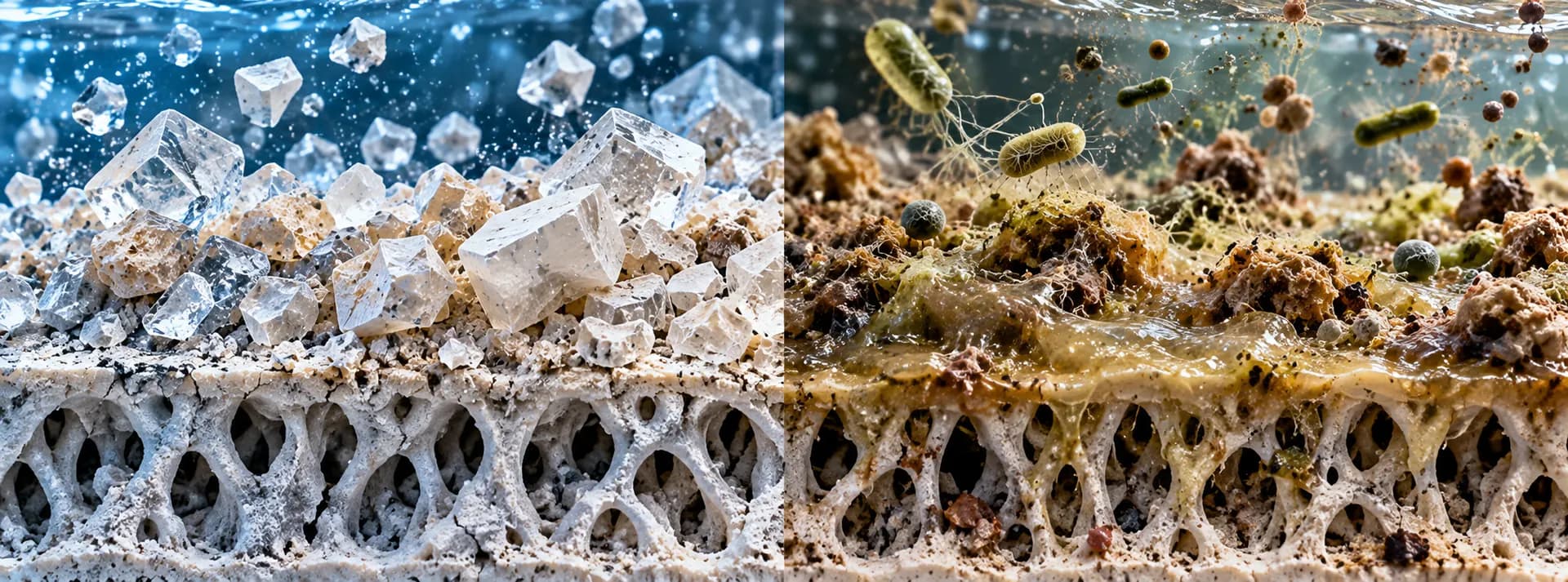
RO troubleshooting orientation
Scaling Is One Possible Cause of RO Performance Decline
A change in permeate flow, differential pressure or salt passage can result from mineral scale, colloidal or particulate fouling, metal deposits, organic fouling, biological growth, compaction, oxidation, leaks or other operating conditions. Start with evidence—not a label.
This page provides a structured basis for distinguishing mineral scaling from other RO fouling and performance problems using water, operating and pretreatment evidence.
Scaling and fouling are related—but not identical
Scaling generally refers to the precipitation and deposition of sparingly soluble mineral salts, such as calcium carbonate, calcium sulfate, barium sulfate and strontium sulfate. Silica-related deposition may involve different mechanisms and should be evaluated separately.
Fouling is the broader category. It can include:
- suspended solids and colloids;
- metal oxides and hydroxides;
- organic material;
- biological growth;
- treatment-chemical interactions;
- mineral scale.
RO membrane deposits can involve multiple mechanisms at the same time. Mineral scale may coexist with colloidal, metal-related, organic or biological material, and the dominant mechanism may change as operating conditions evolve.
Use the correct category before choosing the response
Mineral Scaling
Precipitation of sparingly soluble salts as the feed becomes concentrated. Relevant pages cover silica, carbonate and sulfate scale in more detail.
Related links:
Colloidal and Particulate Fouling
Clay, silt, corrosion products, metal-containing particles and other suspended material can accumulate on membrane surfaces and within feed channels. Pretreatment performance, SDI and turbidity trends may help assess particulate and colloidal fouling risk, but no single test characterises every colloidal contaminant.
Metal-Related Fouling
Iron, manganese and aluminium may enter from source water, corrosion, oxidation or pretreatment carryover. Their form and interaction with coagulants, silica or organics can affect the deposit.
Organic Fouling
Natural organic matter, oils, process contaminants and treatment chemicals may adsorb or form a layer on the membrane. Total organic carbon alone does not define all fouling behaviour.
Biofouling
Microorganisms and extracellular material can create a biofilm. Biological activity may coexist with organic and particulate fouling.
Chemical Interaction Fouling
Anionic antiscalants may interact with residual cationic coagulants and certain metal species. Incompatible chemical programmes, excessive dosing or inadequate mixing can contribute to membrane deposition or fouling.
Mechanical or Chemical Damage
Oxidation, membrane compaction, O-ring leaks, damaged product tubes and other mechanical or chemical damage can produce performance changes that may resemble fouling.
Temperature and operating conditions can change the readings
Permeate flow and salt passage vary with temperature, feed salinity, pressure and other operating conditions. Performance normalisation adjusts measured operating data to a reference basis so membrane-performance trends can be compared more meaningfully.
A useful review may include:
- normalised permeate flow;
- normalised salt passage or rejection;
- differential pressure and its trend under comparable operating conditions;
- feed temperature and conductivity;
- feed, interstage and concentrate pressures;
- permeate and concentrate flows;
- recovery;
- cleaning dates and response;
- source-water or pretreatment changes.
Performance trends should be evaluated using comparable operating conditions and verified data, with instrument accuracy and operating transitions considered before conclusions are drawn.
Similar symptoms can come from different causes
Declining Normalised Permeate Flow
Can be associated with scaling, colloidal or particulate fouling, organic fouling, biofouling, membrane compaction or other conditions that increase resistance to water passage.
Increasing Differential Pressure
Can indicate increased feed-channel resistance caused by particulates, biofilm, precipitated material or mixed deposits. Differential pressure is also influenced by flow rate, temperature and measurement conditions and should be interpreted as a trend.
Increasing Salt Passage
Can result from membrane oxidation or other damage, O-ring or mechanical leaks, severe fouling, temperature changes or other operating conditions. Increasing salt passage alone does not identify the underlying cause.
Visible Deposits
Deposit colour, texture and location can help guide the investigation, but reliable identification may require operating history, water chemistry, inspection evidence or deposit analysis.
Cleaning Response
Improvement or lack of improvement after cleaning may provide information, but an inappropriate chemical or sequence can alter the deposit, damage the membrane or make later diagnosis more difficult.
The RO membrane records what happens upstream
Review the complete pretreatment train:
- intake and source-water variation;
- clarification and coagulation;
- media, cartridge, microfiltration or ultrafiltration steps;
- softening or ion exchange;
- oxidation and dechlorination;
- acid or caustic addition;
- antiscalant, dispersant and their dosing and injection conditions;
- biocide or preservation chemistry;
- chemical tank hygiene and dilution water;
- shutdown and flushing procedures.
Carryover of residual cationic coagulants, metals or inadequately mixed treatment chemicals can contribute to fouling or deposition. Antiscalant compatibility should therefore be reviewed within the complete pretreatment and chemical programme.
Build a timeline before selecting the explanation
Water and System Data
Provide a recent water analysis, system recovery, flows, pressure profile, temperature, membrane and array information.
Normalised Performance History
Include trends before and after the problem, not only the latest value. Mark cleaning, chemical, recovery and source-water changes on the timeline.
Pretreatment Records
Add SDI, turbidity, filter differential pressure, coagulant settings, oxidant and dechlorination records, softener data and other relevant controls.
Chemical Programme
Identify product names, concentrations, injection points, dosing method, dilution water and any recent changes.
Deposit or Inspection Evidence
Where available, include photographs showing deposit location and approximate scale, filter residues, laboratory deposit analysis, membrane inspection or autopsy findings, and relevant cleaning records. Remove personal and confidential information before upload.
Base the cleaning strategy on the identified or suspected foulant
Membrane cleaning should follow the membrane manufacturer’s current guidance and be based on the suspected or identified foulant. Mixed fouling may require a different cleaning strategy or sequence from a confirmed single-mineral deposit.
Where an existing deposit requires diagnosis or cleaning, membrane inspection, deposit analysis and manufacturer-approved cleaning guidance should be used as appropriate.
Technical question, product evaluation or defined purchase?
The Cause of the Performance Change Is Still Unclear
Use Send Your Water Analysis and include the operating and pretreatment history.
The Plant Requires Diagnostic or Cleaning Support
Plant diagnosis, deposit identification and membrane-cleaning support should be handled through an appropriate engineering, membrane-service or laboratory provider. ALPHX can review relevant water, system and chemical-programme information where an antiscalant evaluation is required.
The Product and Requirement Are Already Specified
Use Send Your Water Analysis and attach the specification or RFQ.
You Are Researching a Specific Scale Risk
Membrane Scaling and Fouling FAQs
Start with evidence
Describe the symptom without assuming the cause
Submit the water analysis, operating history, pretreatment details and current chemical programme to establish the technical basis for evaluating the likely fouling mechanism and any relevant scale-control requirements.