
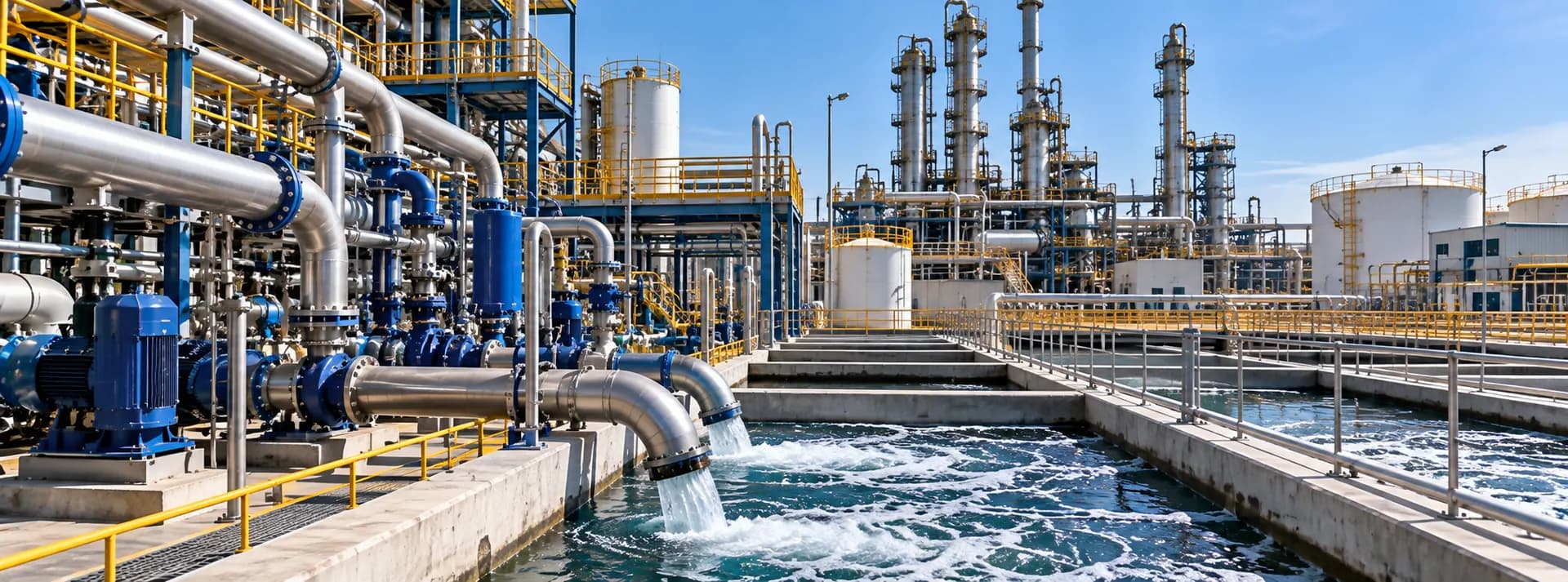
Industrial RO and process water
Frame the Antiscalant Requirement Around the Industrial Process
In industrial water treatment, the RO system may support a utility or production step with its own water-quality, continuity, documentation and chemical-control requirements. A useful enquiry connects those requirements to the feedwater and operating basis.
Product suitability and dosing must be evaluated against the specific water, RO system, process requirements and site standards.
Start with the role of the permeate
The same RO design question can have a different business and technical importance depending on what the permeate supports. A change in salt passage, availability or chemical documentation may be treated differently when the water feeds a boiler system, production process, cooling-water programme, cleaning operation or reuse scheme.
A stronger enquiry explains:
- what the permeate is used for;
- the required water-quality parameters;
- whether operation is continuous, batch or seasonal;
- the consequence of reduced capacity or off-specification water;
- upstream and downstream treatment steps;
- who approves chemicals and product changes at the site.
Different industrial uses create different enquiry priorities
Utility-Water Preparation
RO may form part of boiler makeup, cooling-water makeup or general utility-water production. The enquiry should identify downstream polishing, chemical treatment and quality requirements.
High-Purity or Polishing Pretreatment
RO may precede ion exchange, electrodeionisation or another polishing stage. Feed variability and RO performance can influence downstream loading and operating stability.
Water Reuse or Variable Industrial Sources
Reclaimed or mixed industrial water can have variable organic, colloidal, biological and mineral conditions. Antiscalant addresses specific mineral-scaling risks and does not replace the wider fouling-control programme.
Multi-Site Industrial Procurement
A group may seek consistent documentation and purchasing across several plants. Each site may still require its own water, system and approval review.
State what must remain stable
An industrial enquiry may need to address:
- minimum and normal RO production;
- required permeate quality;
- operating schedule and redundancy;
- planned shutdown or maintenance windows;
- feedwater variation and production campaigns;
- chemical storage and handling constraints;
- consequences of changing supplier or product;
- on-site approval, management-of-change or trial requirements;
- emergency versus planned procurement status.
These details help distinguish a routine RFQ from a technical change that requires additional review.
Connect the process requirement to the actual RO basis
Feedwater and Pretreatment
- source and representative analysis;
- sampling point, date and units;
- temperature and variability;
- pretreatment and current chemical additions;
- turbidity, SDI, metals, organics or microbiological context where relevant;
- known production or seasonal changes.
RO Design and Operation
- capacity and recovery;
- membrane details and staging;
- pressure, temperature, flows and permeate conductivity;
- current product and dose basis;
- normalised trends where available;
- recent cleaning, maintenance or operating changes.
Process and Site Requirements
- permeate end use;
- critical water-quality limits;
- site chemical restrictions;
- restricted substances or material-compliance requirements;
- required quality, safety or regulatory documents;
- trial, change-control or approval process.
Industrial approval may depend on more than the TDS
A Technical Data Sheet is only one part of product qualification. Depending on the site, procurement stage and end use, additional documentation or evidence may be required:
- Safety Data Sheet and classification information;
- Certificate of Analysis format or batch documentation;
- composition or restricted-substance declarations where legally appropriate;
- product origin and manufacturer identity;
- packaging and labelling details;
- shelf-life and storage requirements;
- food-contact, potable-water or sector-specific evidence where applicable;
- membrane compatibility evidence or documented comparison with a reference product;
- change-control, sample, trial or approved-supplier documentation.
Certification, approval and declaration availability is confirmed only after the documentation for the named product has been reviewed.
Start the enquiry that matches the stage of the requirement
Discuss Your Requirement
Use this route when the application is at an early stage, the process context needs clarification or the appropriate technical-commercial route is not yet clear.
Send Your Water Analysis
Use this enquiry when water and system information is available for technical review, when the product, specification, quantity, destination, documentation and purchasing timing are already defined, or when both apply.
Industrial Water Treatment FAQs
Prepare the industrial enquiry
Explain the process role, water basis and decision required
Submit the available water analysis and industrial-process information. ALPHX will review the application and establish the appropriate basis for product evaluation and commercial coordination.