
RO technical challenge
Carbonate Scaling Depends on More Than Calcium Hardness
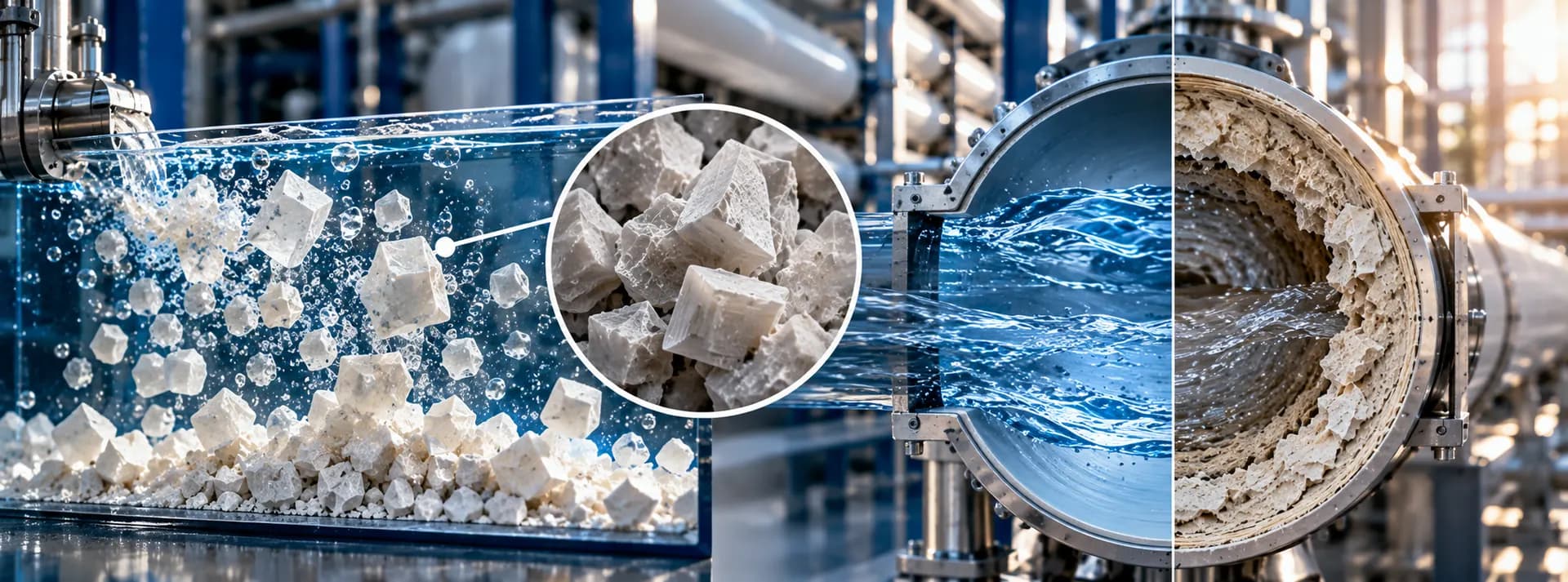
Calcium carbonate scaling risk depends on the relationship between calcium, alkalinity, pH, temperature, dissolved solids and the concentration effect created by RO recovery.
How Carbonate Scale Develops in RO Systems
As RO recovery increases, many rejected dissolved constituents become more concentrated in the concentrate stream. Calcium and carbonate species can then approach or exceed conditions at which calcium carbonate precipitation becomes thermodynamically favourable.
The carbonate system is strongly influenced by pH and alkalinity. Dissolved carbon dioxide, bicarbonate and carbonate exist in a pH-dependent equilibrium. Temperature and ionic strength also affect carbonate equilibria and saturation calculations.
Evaluate Calcium Together with Alkalinity and pH
Calcium
Calcium is a major component of hardness and is directly involved in calcium carbonate precipitation. Its feed concentration is only the starting point; the calculated concentrate conditions at the relevant RO recovery must also be considered.
Alkalinity
Alkalinity represents the water’s acid-neutralising capacity and, in many RO feedwaters, is largely associated with bicarbonate and carbonate species. The reporting basis must be clear, for example as mg/L as CaCO₃ or as individually reported bicarbonate and carbonate species.
pH and Carbon Dioxide
pH strongly influences the distribution of dissolved carbon dioxide, bicarbonate and carbonate species. Acid addition can shift bicarbonate toward dissolved carbon dioxide and reduce calcium carbonate saturation, but it also changes the broader water chemistry and treatment programme.
Temperature and Ionic Strength
Temperature affects calcium carbonate equilibrium and scaling tendency. Dissolved-solids concentration and ionic strength also influence activity coefficients and the interpretation of saturation calculations, particularly in higher-salinity waters.
Recovery
Higher recovery generally increases the concentration of rejected constituents in the concentrate stream. A change in recovery can therefore change calcium carbonate saturation and scaling potential even when the feedwater analysis remains unchanged.
Carbonate Scaling Requires a System-Level Assessment
A useful review should include:
- calcium concentration and reporting units;
- magnesium concentration and total-hardness context;
- alkalinity and, where available, bicarbonate and carbonate data;
- feed pH and, where measured or reliably calculated, concentrate pH;
- temperature range;
- conductivity or total dissolved solids;
- actual and design recovery;
- acid type, concentration, dose and injection basis, if used;
- softener performance, if used;
- current antiscalant product, dose and dose-control method;
- variations in source water or blending.
Water analyses should be checked for unit consistency and ionic balance where sufficient analytical data are available. A materially unbalanced analysis may indicate missing constituents, inconsistent reporting bases, transcription errors or analytical uncertainty that can affect the scaling projection.
LSI and Related Indices Must Be Interpreted in Context
The Langelier Saturation Index (LSI) is commonly used to describe calcium carbonate saturation tendency in relatively low-ionic-strength waters. For higher-ionic-strength waters, methods that account more explicitly for ionic-strength effects, such as Stiff–Davis-type approaches, may be more appropriate depending on the application and calculation method.
A saturation index helps characterise scaling tendency and should be interpreted together with concentrate conditions, the calculation method and product-specific application data.
A responsible interpretation should confirm:
- whether the calculation uses feed or concentrate conditions;
- the temperature and ionic-strength basis;
- acidification and carbon-dioxide assumptions;
- recovery and concentration factors;
- the software or calculation method;
- the product-specific saturation allowance and calculation basis, where an antiscalant is proposed.
Acid Dosing, Softening, Recovery Control and Antiscalant Treatment Are Not Interchangeable
Acidification
Acid addition can lower pH and shift carbonate-system equilibrium. Acid type, concentration and dose require competent design because acid addition also affects materials compatibility, safety, downstream chemistry and other scaling risks. Sulfuric acid, for example, adds sulfate to the water and may increase the importance of calcium, barium or strontium sulfate scaling assessments.
Softening
Ion-exchange softening can reduce calcium and magnesium concentrations entering the RO system. Its suitability depends on feedwater composition, plant design, regeneration and operational requirements.
Recovery Adjustment
Lowering RO recovery reduces the concentration factor but also changes permeate production and concentrate volume. It is an operating and economic decision, not only a chemical one.
Antiscalant
An antiscalant may be used alone or with other control measures, depending on the approved product, water chemistry and application. The allowable saturation basis and required dose must be determined using product-specific methodology together with the actual water analysis and RO operating conditions.
Preventive Cleaning or Other Plant Strategies
Some systems use preventive cleaning or other specialised strategies. These should be selected according to the identified deposit, RO operating conditions and applicable membrane-manufacturer guidance.
Investigate the Cause Before Selecting a Cleaning or Chemical Response
Potential observations include reduced normalised permeate flow, increased differential pressure, increased normalised salt passage, visible deposits or performance changes following interruption of acid or antiscalant dosing.
These observations can also occur with sulfate scale, silica, colloids, metal deposits, organic fouling, biofouling or mechanical problems. A predominantly calcium-carbonate deposit may require a different cleaning approach from a mixed, sulfate-rich or silica-rich deposit. An unsuitable cleaning chemistry or sequence can worsen membrane performance or make a mixed-deposit problem more difficult to resolve.
Prepare the Complete Carbonate-Scaling Basis
Water Chemistry
- calcium;
- magnesium;
- alkalinity and reporting basis;
- bicarbonate and carbonate, if reported;
- pH;
- temperature;
- conductivity or total dissolved solids;
- sulfate;
- silica;
- barium and strontium, particularly where sulfate scaling may also be relevant;
- iron, aluminium and other reported constituents.
RO Operating Data
- design and actual recovery;
- feed, permeate and concentrate flows;
- membrane and array information;
- feed and concentrate pH where available;
- feed pressure, differential pressure and normalised performance history;
- seasonal and source-water variation.
Pretreatment and Chemicals
- acid type, concentration, dose and control method;
- softening or lime-treatment details;
- coagulants and filtration;
- current antiscalant product, dose, dilution method and injection point;
- recent chemical or operating changes.
Sound Chemistry Still Requires Reliable Dosing and System Operation
Even when the selected product and calculated dose are appropriate, field performance can be affected by:
- empty or incorrectly prepared chemical tanks;
- blocked injection lines;
- incorrect or unverified dosing-pump calibration;
- inadequate mixing;
- variable feed flow without proportional chemical dose pacing;
- pH-probe calibration error or measurement drift;
- poorly designed acid and antiscalant injection locations or insufficient mixing between injection points;
- unrecorded recovery changes;
- shutdown without suitable flushing;
- chemical interactions with pretreatment residuals or carryover.
A technical-commercial enquiry should therefore describe both the calculation basis and how each chemical is actually prepared, diluted, measured, controlled and injected.
Carbonate Scaling FAQs
Prepare a carbonate-scale enquiry
Submit Calcium, Alkalinity and Actual RO Operating Conditions Together
A complete enquiry allows feedwater chemistry and projected concentrate conditions to be evaluated together and establishes the basis for the appropriate technical and commercial next step.