
RO antiscalant
Water-Analysis-Led RO Antiscalant Evaluation
Understand the scale risks, water and system inputs, documentation needs and commercial information required for a responsible RO antiscalant enquiry with ALPHX in Dubai.
Product selection and dosing are evaluated against the relevant water chemistry, RO system conditions and product-specific documentation.
In practical terms
Antiscalant is one part of a complete RO scale-control approach
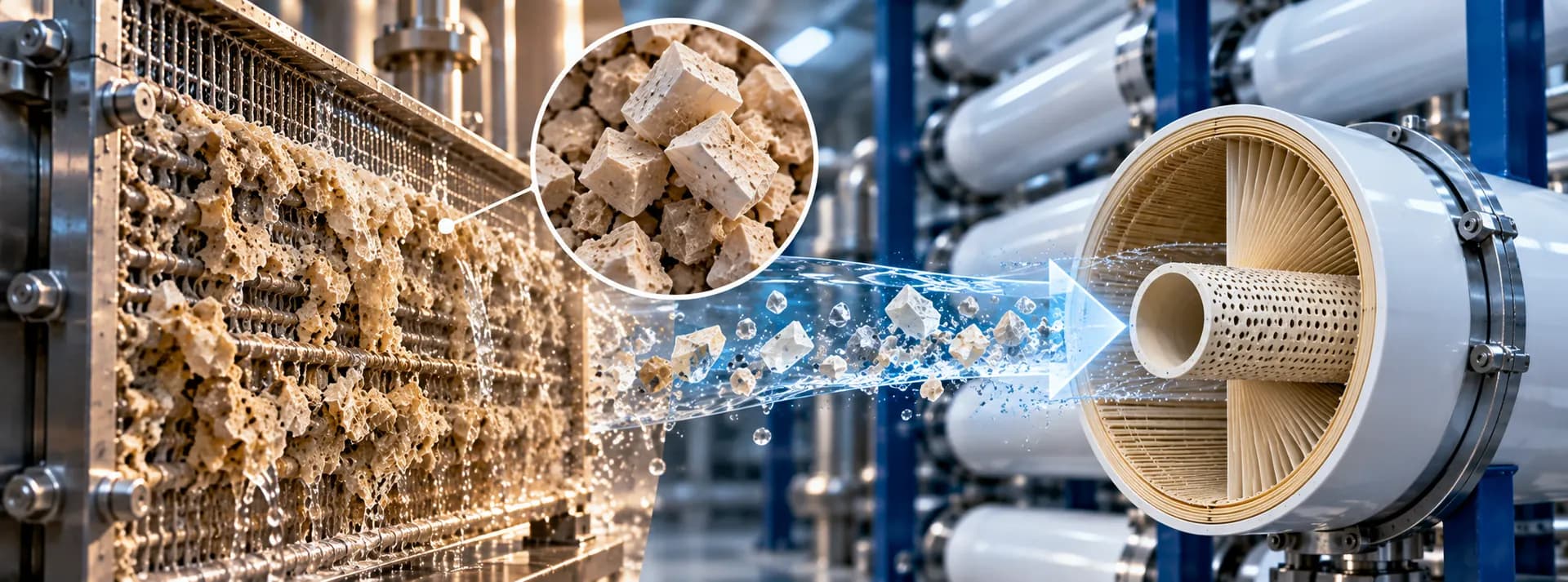
Reverse osmosis concentrates dissolved salts in the reject stream. When certain sparingly soluble salts become sufficiently concentrated under the prevailing pH, temperature and operating conditions, they may precipitate and form mineral scale.
RO antiscalants are chemicals used to inhibit the precipitation and growth of certain scale-forming minerals. Their suitability and application limits depend on the product chemistry, water analysis, RO design and pretreatment context.
Antiscalant works as part of the overall RO treatment strategy, alongside appropriate pretreatment, membrane selection, system design, cleaning and operating control.
A chemical treatment used to manage specific mineral-scale risks
Antiscalants are commonly added to RO feedwater upstream of the membrane elements as part of the pretreatment and chemical dosing programme. Depending on their chemistry and approved application, they may help control the precipitation and crystal growth of carbonate, sulfate, fluoride and silica-related scales.
Different antiscalant chemistries can behave differently in different waters. Product selection therefore requires more than identifying a general “scale problem”. The proposed product must be assessed against the water, operating conditions, pretreatment chemicals, membrane requirements and supporting product documentation.
Concentration matters
RO recovery changes the conditions on the concentrate side
As water passes through the membrane, dissolved constituents are retained and become more concentrated in the reject stream. Higher recovery generally increases this concentration effect and can increase the risk that a sparingly soluble salt reaches conditions where precipitation is possible.
Scale potential is not determined by concentration alone. Relevant factors can include:
- ionic composition of the feedwater;
- recovery rate and concentration factor;
- pH and alkalinity;
- temperature;
- pretreatment and chemical interactions;
- membrane-system design and operating conditions;
- the form of silica, metals or suspended material present.
This is why the feedwater analysis and system information should be considered together.
Technical challenges
The scale type influences the information required
Carbonate Scale
Explore Carbonate ScalingCalcium carbonate scale potential is influenced by calcium, alkalinity, pH, temperature, dissolved solids and the concentration conditions in the RO system. Acid addition and antiscalant treatment are different scale-control approaches and must be evaluated in the full pretreatment context.
Sulfate Scales
Explore Sulfate ScalingCalcium sulfate, barium sulfate and strontium sulfate may become relevant when sulfate and the corresponding cations are concentrated in the RO reject stream. Accurate analysis is important because some ions may matter even when present at relatively low levels.
Silica-Related Scale and Deposition
Explore Silica ScalingSilica behaviour can depend on concentration, pH, temperature, recovery, dissolved versus colloidal form and interactions with metals such as iron or aluminium. Silica-related risk should not be reduced to a single generic threshold.
Other Potential Scales
Calcium fluoride and calcium phosphate scales may be relevant in some waters or process conditions. Their presence and practical significance must be reviewed from the actual analysis and system context.
Scaling is not the same as every form of fouling
Diagnose the mechanism before assuming the treatment
Scaling
Scaling generally refers to the precipitation and deposition of mineral salts that form crystalline or mineral deposits.
Fouling
Fouling is a broader term and may involve colloidal particles, suspended matter, metal oxides, organic material, biological growth or interactions between treatment chemicals.
A pressure, flow or salt-passage change does not by itself prove that mineral scale is the cause. Antiscalant is not a universal treatment for every membrane-performance problem.
General mechanism
Inhibiting precipitation and crystal growth
Depending on its chemistry, an antiscalant may interfere with one or more stages of scale formation, including crystal nucleation, crystal growth and agglomeration. This can allow an RO system to operate under concentration conditions that would otherwise have a higher precipitation risk.
The practical effect is product- and application-specific. It depends on appropriate product selection, dosing, injection, dilution, pretreatment compatibility and operating control.
Some antiscalant chemistries may interact unfavourably with cationic coagulants, residual iron, aluminium or other constituents present in the feedwater. The complete pretreatment programme should therefore be considered rather than evaluating the antiscalant in isolation.
Nucleation
Crystal formation begins
Growth
Crystals increase in size
Agglomeration
Crystals cluster together
No universal selection
What should be reviewed before a product is proposed?
Water Chemistry
Relevant cations, anions, silica, alkalinity, pH, temperature, dissolved solids and other water-quality parameters should be supplied with units and a sample date.
RO Design and Operation
System capacity, recovery, staging, feed and concentrate conditions, membrane information and operating variability may affect the evaluation.
Pretreatment
Filtration, softening, acid dosing, coagulation, dechlorination and other chemical additions can change the scale-control context or introduce compatibility concerns.
Current Chemical Programme
The existing antiscalant, dose, injection point, dilution practice and observed operating conditions can help explain the current system performance.
Required Documents and Market Conditions
Application requirements, destination, required product documentation, packaging, quantity, purchasing stage and commercial terms should be identified separately from technical suitability.
Water and system data
A stronger enquiry starts with complete, current and clearly labelled information
Water-Analysis Information
Where available, include:
- water source, sample identification and analysis date;
- pH and temperature range;
- conductivity and/or total dissolved solids;
- calcium, magnesium, sodium and potassium;
- bicarbonate, carbonate and total alkalinity;
- sulfate, chloride, nitrate, fluoride and phosphate;
- silica, identified as soluble/reactive and colloidal where the laboratory provides that distinction;
- barium and strontium;
- iron, aluminium and manganese;
- total hardness, turbidity and Silt Density Index where available;
- other relevant process contaminants or treatment residuals.
RO System Information
Where available, include:
- application and feedwater source;
- design and current system capacity;
- recovery rate;
- membrane manufacturer and model;
- number of stages and array information;
- feed, permeate and concentrate data;
- pretreatment process;
- current chemical programme and dose;
- current operating concern and available trend data.
Commercial Information
For an RFQ, include:
- estimated quantity;
- preferred or required packaging;
- delivery destination and port, where relevant;
- target purchasing timeline;
- Incoterm preference;
- required documentation;
- trial, evaluation or commercial purchasing stage.
Submit the information available. ALPHX may request additional data before confirming a product-specific recommendation or commercial position.
Application-specific dosing
Why a universal dose should not be published
Antiscalant dose depends on the proposed product and the concentration conditions it is intended to manage. Relevant variables may include water chemistry, recovery, temperature, pH, scale saturation, pretreatment chemicals, product formulation and the manufacturer’s approved projection method.
Under-dosing may leave the target scale risk insufficiently controlled. Excessive or poorly managed dosing may increase chemical consumption and, depending on product chemistry and system conditions, may contribute to operational or compatibility issues.
A dose should therefore be confirmed against an identified product, an appropriate calculation or projection, the membrane and pretreatment context, and approved supplier documentation.
Antiscalant dosing is application-specific and should be determined from the feed-water chemistry, recovery, operating conditions and selected product.
Product selection alone does not replace system control
A scale-control programme may also depend on:
- stable and calibrated dosing equipment;
- suitable injection and mixing;
- correct dilution and solution-tank management where dilution is used;
- monitoring of feedwater changes;
- control of recovery, pH and temperature;
- management of iron, aluminium, suspended material and biological risk;
- compatibility with coagulants, flocculants and other treatment chemicals;
- membrane-manufacturer limits and operating guidance;
- routine performance normalisation and investigation of abnormal trends.
Procurement review
Confirm the documentation for the proposed product and transaction
Depending on the enquiry, buyers may request:
- Technical Data Sheet (TDS);
- Safety Data Sheet (SDS);
- Certificate of Analysis (COA) or batch documentation;
- product origin;
- packaging options;
- storage and shelf-life information;
- membrane compatibility or approval evidence where applicable;
- regulatory or application-specific documentation;
- minimum order quantity, lead time and Incoterms.
Product selection is supported by relevant technical documentation, including applicable product data, compatibility information and application guidance.
Technical-commercial review
From available information to the next documented step
- 1
Submit Water and System Information
Upload the available analysis and describe the application, RO system and main concern. - 2
Review Completeness and Relevance
ALPHX reviews the available water, system and application information to establish the basis for product-specific evaluation. - 3
Confirm Additional Requirements
Any additional technical or commercial information required to complete the evaluation is identified and clarified with the customer. - 4
Confirm Product and Commercial Information
Following technical review, ALPHX defines the appropriate product, application basis, supporting documentation and applicable commercial terms.
RO Antiscalant FAQs
An RO antiscalant is a chemical used as part of a scale-control programme to inhibit the precipitation or growth of certain mineral scales in reverse osmosis systems. Product chemistry and application range vary.
No universal suitability should be assumed. Water chemistry, recovery, temperature, pH, pretreatment, membrane context and product documentation should be reviewed for the individual application.
No. Capacity does not define the concentration and scale conditions by itself. Dose is product- and application-specific and should be based on the relevant water and system data and approved calculation method.
No. Antiscalants target specified scale risks. Colloidal, organic, biological and other fouling mechanisms may require different pretreatment, monitoring or cleaning measures.
Recovery affects how strongly dissolved constituents are concentrated in the reject stream. Temperature can change salt and silica solubility and may alter scale potential. Both should be included in the review.
Metals and pretreatment chemicals may contribute to deposits or interact with some antiscalant chemistries. The full pretreatment programme and water analysis should be considered.
No. It is the starting point. RO design, operating data, pretreatment, membrane information and purchasing requirements may also be needed. Submission does not guarantee a specific product or dose.
Buyers commonly request a TDS, SDS, COA, origin and packaging information. Availability and applicability are confirmed for the specific proposed product and transaction.
An RFQ can be submitted at any stage. A commercial response may require clarification of the product, specification, quantity, destination, documentation and technical suitability before terms are confirmed.
ALPHX is based in Dubai for commercial and technical-commercial coordination. The origin of a proposed product is confirmed for the specific enquiry and should not be inferred from the ALPHX location.
Prepare the next step
Share the water, system and purchasing information available
Begin with water analysis and RO operating information for technical and commercial review, or submit a defined RFQ for commercial evaluation.
Additional information may be requested. Submission does not confirm product suitability, dose, documentation or quotation.