
RO technical challenge
Silica Scaling Assessment Requires More Than a Single Silica Result
Silica behaviour in an RO system can depend on its form, concentration, pH, temperature, recovery, pretreatment and interactions with metals. A responsible review connects the laboratory report to the actual operating basis.
Why Silica Can Be a Complex RO Scaling Challenge
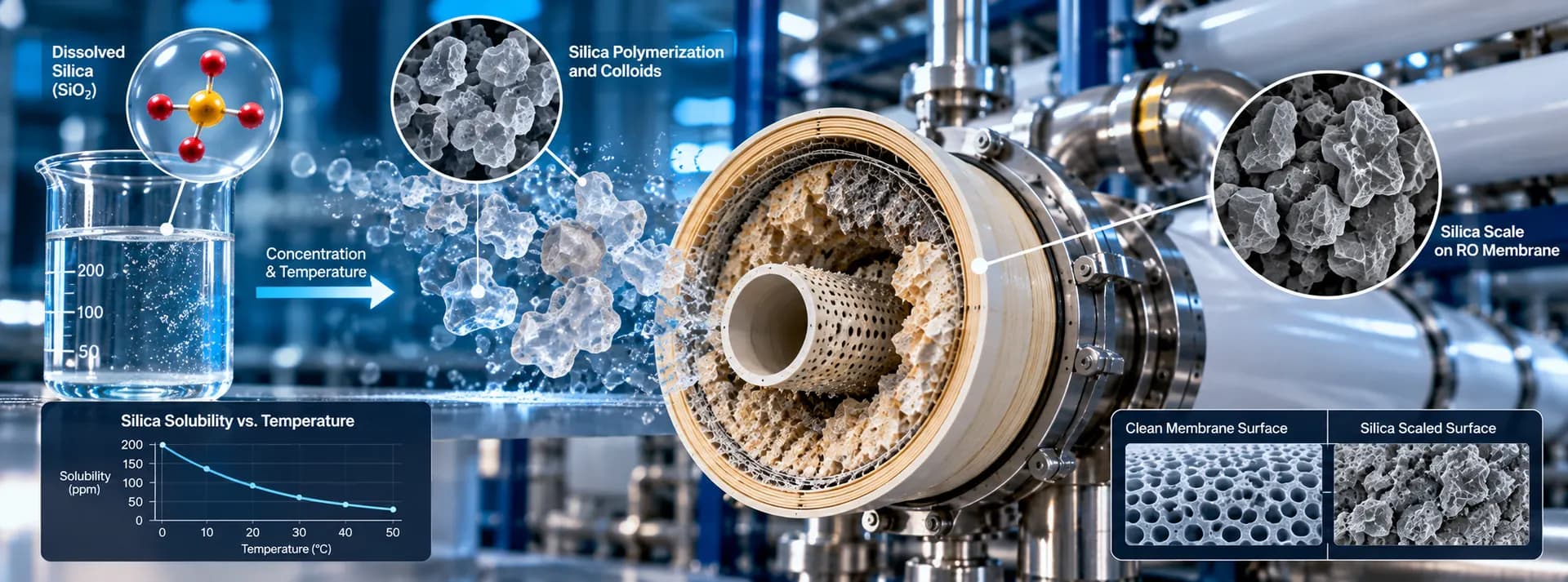
RO membranes reject much of the dissolved mineral load, producing a more concentrated reject stream. As recovery increases, silica and other constituents can become more concentrated. If conditions favour precipitation, polymerisation or interaction with other constituents, silica-related deposits may form within the system.
Silica is not a single, uniform category. A reported laboratory result may represent dissolved reactive silica, total silica or another method-specific measurement. Colloidal silica, polymerised silica and metal-associated silicates can behave differently from dissolved reactive silica. That distinction affects both pretreatment and scale-control discussions.
“Silica” Can Refer to Different Forms
Dissolved Silica
Dissolved reactive silica is commonly present predominantly as silicic acid under many natural-water conditions. Its solubility and tendency to polymerise are strongly influenced by temperature, pH and concentration. In RO evaluation, the concentrate condition matters more than the feed value alone.
Polymerised Silica
When dissolved silica becomes sufficiently supersaturated, polymerisation can lead to gel-like or adherent silica deposits. This type of deposit can be difficult to remove and should not be treated as interchangeable with a crystalline carbonate scale.
Colloidal Silica
Colloidal silica consists of very small suspended or dispersed silica particles rather than dissolved reactive silica. It may pass through inadequate pretreatment and contribute to particulate or mixed fouling. Antiscalant selection alone may not control a colloidal-silica fouling problem.
Metal Silicates and Mixed Deposits
Aluminium and iron can interact with silica and contribute to complex silica-containing deposits. Mixed deposits may also contain organics, colloids or metal hydroxides. Appearance alone does not reliably identify the mechanism.
Feedwater Silica Is Only the Starting Point
An RO system separates the feed stream into permeate and concentrate. The concentrate stream contains higher concentrations of many rejected constituents, and this concentration effect generally increases as system recovery rises.
A silica review should therefore consider:
- feed silica and the analytical method;
- actual and design recovery;
- concentrate conditions;
- temperature variation;
- feed and concentrate pH;
- total alkalinity where relevant to the calculation method;
- seasonal or source-water changes;
- blending and pretreatment effects.
A silica concentration that appears moderate in the feed may become more significant after concentration in the RO system. Conversely, a single high feed-silica result does not by itself confirm that silica scaling is occurring.
Silica Risk Can Be Influenced by the Pretreatment Programme
Aluminium-based coagulants are widely used in water treatment. If residual or carryover aluminium reaches the RO membranes, it may contribute to fouling and interact with silica. Iron can create similar complications depending on its concentration, form and the prevailing water chemistry.
For a useful review, provide:
- coagulant name and chemistry, if used;
- normal and maximum coagulant dose, if known;
- clarification or membrane-pretreatment details;
- measured iron and aluminium;
- sample point and filtration status;
- evidence of carryover or pretreatment upset;
- current antiscalant and any other chemical feeds.
Performance Changes Require Investigation Before Being Attributed to Silica
Potential observations may include:
- reduced normalised permeate flow;
- increasing differential pressure;
- a change in normalised salt passage;
- white, beige, glassy or gel-like deposits;
- shorter operating intervals;
- changes after a source-water or recovery adjustment.
These signs are not specific to silica. Similar symptoms may result from carbonate scale, sulfate scale, colloidal material, metal oxides, organic fouling, biofouling, compaction or mechanical issues.
A more complete investigation may include operating trends, concentrate chemistry, deposit analysis, membrane inspection, cleaning response or other appropriate diagnostic methods.
Review Water Chemistry and Operating Data Together
Water Analysis
Provide a recent, representative water-analysis report with units and analytical methods where available. Relevant items may include:
- silica, including the reported form, basis and analytical method;
- pH and temperature;
- conductivity or total dissolved solids;
- calcium and magnesium;
- alkalinity or bicarbonate;
- sulfate;
- iron and aluminium;
- manganese;
- turbidity and SDI where available;
- other constituents reported by the laboratory.
System Information
Include:
- design and actual recovery;
- feed, permeate and concentrate flow where known;
- membrane brand and model, if known;
- staging and array configuration;
- operating temperature range;
- feed and concentrate pH;
- pretreatment steps;
- current chemical programme;
- recent changes and performance history.
Sampling Context
State the sampling point, sample date, water source, whether the sample was filtered, and whether the result represents normal, seasonal, blended or upset operating conditions.
Silica Control May Require More Than Antiscalant Treatment
Depending on the identified mechanism, water chemistry and approved product basis, a control strategy may involve a combination of:
- appropriate pretreatment for colloidal material;
- control of aluminium, iron and coagulant residuals or carryover;
- recovery review;
- pH and temperature evaluation;
- product-specific antiscalant selection;
- accurate antiscalant dosing, dilution, mixing and injection;
- shutdown and flushing practices;
- monitoring of normalised performance;
- cleaning or specialist investigation when deposits already exist.
Silica-control strategies should be selected according to the identified mechanism, water chemistry and RO operating conditions. Changes to recovery, pH, pretreatment or cleaning strategy should be evaluated within the overall membrane-treatment programme.
Silica Scaling FAQs
Prepare a silica-focused enquiry
Connect Silica Results to the Actual RO Operating Conditions
Submit the water analysis, sampling context and RO operating conditions. ALPHX will review the available information and establish the basis for the appropriate technical and commercial next step.