
RO technical challenge
Sulfate Scale Risk Depends on Both Sulfate and the Corresponding Cation
Calcium, barium and strontium sulfates do not have identical solubility or scaling behaviour. A responsible review requires the relevant ion concentrations, RO recovery, temperature, ionic-strength conditions and the actual chemical programme.
Sulfate-scale evaluation is application-specific and should consider the relevant ion concentrations, RO operating conditions and product-specific technical basis.
“Sulfate Scaling” Is Not a Single Calculation
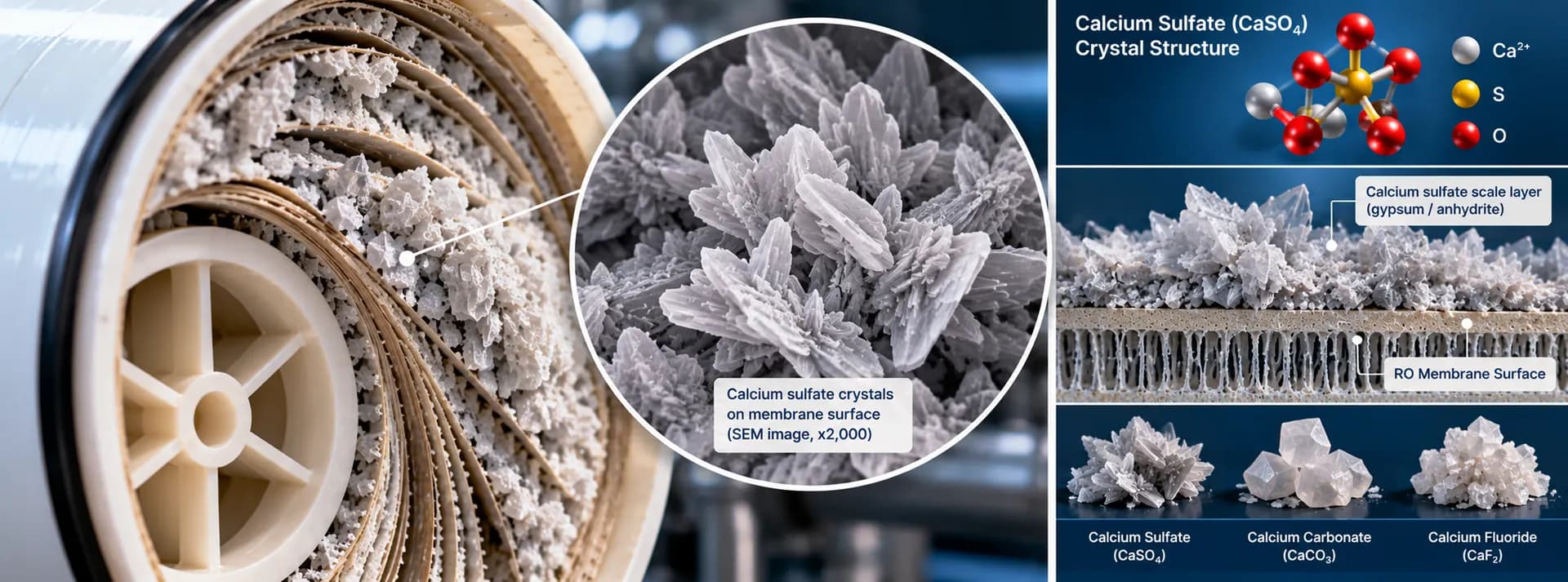
Sulfate can combine with calcium, barium or strontium to form sparingly soluble sulfate salts. RO concentration can increase the ion product in the concentrate stream and move the water toward supersaturation and possible precipitation.
Barium sulfate and strontium sulfate may become relevant even when barium or strontium is present only at low concentrations because these salts have low solubility. Analytical reporting limits, detection limits and units therefore matter. A report that omits barium or strontium may be insufficient for a sulfate-scaling assessment.
Evaluate Each Sulfate Salt Separately
Calcium Sulfate
Calcium sulfate scaling risk depends on calcium and sulfate concentrations in the concentrate, together with recovery, temperature and ionic strength. It is a different calculation from calcium carbonate scaling and should not be inferred from LSI.
Barium Sulfate
Barium sulfate is highly insoluble. Very low barium concentrations can therefore become technically relevant after concentration in the RO concentrate. The analytical method and reporting or detection limit should be sufficiently sensitive for the required evaluation.
Strontium Sulfate
Strontium sulfate is also sparingly soluble and should be evaluated using sulfate concentration and the projected concentrate conditions. A “not detected” result is only useful when the analytical reporting or detection limit is known and sufficiently low for the intended scaling assessment.
Mixed-Scale Conditions
More than one mineral phase may approach saturation simultaneously, while deposits may also contain carbonate, silica, metal-containing solids or colloidal material. Product selection should therefore be based on the complete water chemistry, RO operating conditions and relevant product-specific performance data.
Analytical Detection Limits Are Part of the Result
For barium and strontium, “zero”, “not detected” and “below a stated reporting or detection limit” are not equivalent analytical statements and can lead to different scaling assessments.
A useful laboratory report should show:
- analyte name;
- result;
- unit;
- reporting limit and/or method detection limit where relevant;
- sample point and date;
- analytical method, particularly for low-level barium and strontium results;
- whether the sample represents normal operation.
Unit errors can create major scaling-calculation errors. Confirm whether each result is reported in mg/L, µg/L, mmol/L or another stated basis before entering it into RO design or antiscalant projection software.
Evaluate Concentrate Chemistry Together with RO Operating Conditions
A sulfate review should consider:
- sulfate concentration;
- calcium, barium and strontium;
- design and actual recovery, together with the applicable concentration factor;
- temperature;
- total dissolved solids and calculated ionic strength;
- pH where relevant to the complete scaling and chemical-treatment assessment;
- blending and seasonal source variation;
- acid addition;
- softening or other pretreatment;
- current antiscalant product, dose and product-specific projection methodology;
- actual versus design feed, permeate and concentrate flows.
Higher dissolved-solids conditions can alter ionic activities and solubility relationships. For this reason, simple multiplication of feed concentrations by a nominal concentration factor should not replace an appropriate saturation calculation or approved product-specific projection method.
Changes to Carbonate-Scale Control Can Affect Sulfate-Scale Risk
Sulfuric acid adds sulfate to the feedwater. When it is used for pH adjustment, the sulfate introduced by the acid must be included in the sulfate-scaling assessment. Selecting an acid programme solely from a calcium-carbonate perspective can therefore overlook calcium, barium or strontium sulfate scaling risk.
Other pretreatment factors may include:
- sodium-cycle cation-exchange softening, which reduces hardness cations but whose removal performance for trace barium and strontium should be verified for the specific system;
- lime softening or other precipitation-based pretreatment;
- source blending;
- filtration and control of suspended or metal-containing solids;
- coagulants and chemical interactions;
- changes in RO recovery following pretreatment or operating modifications.
The full pretreatment train, chemical additions and their effect on the RO feedwater composition should be described in the enquiry.
Prevention and Early Investigation Are Critical
Barium- and strontium-sulfate deposits can be particularly difficult to remove from RO systems compared with readily acid-soluble calcium-carbonate scale. Cleaning strategy should therefore be based on deposit composition, membrane chemical limits, cleaning-agent compatibility, temperature, pH and the membrane manufacturer’s approved guidance.
Potential system observations can include reduced normalised permeate flow, increased differential pressure and changes in normalised salt passage. These symptoms are not specific to sulfate scale and may have multiple causes.
Provide Water Chemistry, Analytical Limits and Operating Context
Essential Water-Analysis Parameters
- sulfate;
- calcium;
- barium;
- strontium;
- pH and temperature;
- conductivity or total dissolved solids;
- alkalinity;
- silica;
- iron and aluminium;
- other major reported ions needed for ionic-balance checking and scaling projection.
Analytical Context
- units for every result;
- reporting and/or detection limits for low-level barium and strontium results;
- sample point and date;
- laboratory and analytical method where available;
- filtered or unfiltered basis where relevant.
System and Chemical Information
- design and actual recovery;
- feed and concentrate flows;
- acid type, concentration, dose and dose-control method;
- current antiscalant product, dose and injection point;
- membrane and array information;
- pretreatment steps;
- seasonal or blended-water scenarios;
- recent operating changes.
Use a Product-Appropriate Calculation and an Operable Chemical Programme
A sulfate-control review may consider:
- improving analytical completeness and confirming low-level barium and strontium data;
- reducing or controlling the relevant scaling ion through suitable pretreatment where technically appropriate;
- reviewing acid selection, concentration and dosage, including sulfate introduced by sulfuric acid;
- adjusting recovery or blending;
- selecting an antiscalant with documented performance for the specific sulfate salts and application;
- confirming product-specific saturation allowances, calculation methodology and dose;
- verifying chemical preparation, injection, mixing and dosing-pump calibration;
- monitoring changes in source water and performance;
- planning competent investigation if deposits already exist.
Performance against calcium, barium and strontium sulfate should be evaluated according to the specific scale coverage and application limits supported by the selected product’s technical documentation.
Sulfate Scaling FAQs
Prepare a sulfate-scale enquiry
Include Calcium, Barium and Strontium — Not Sulfate Alone
Submit a representative water analysis, including appropriate low-level barium and strontium data, together with the RO operating conditions and current chemical programme for technical review.